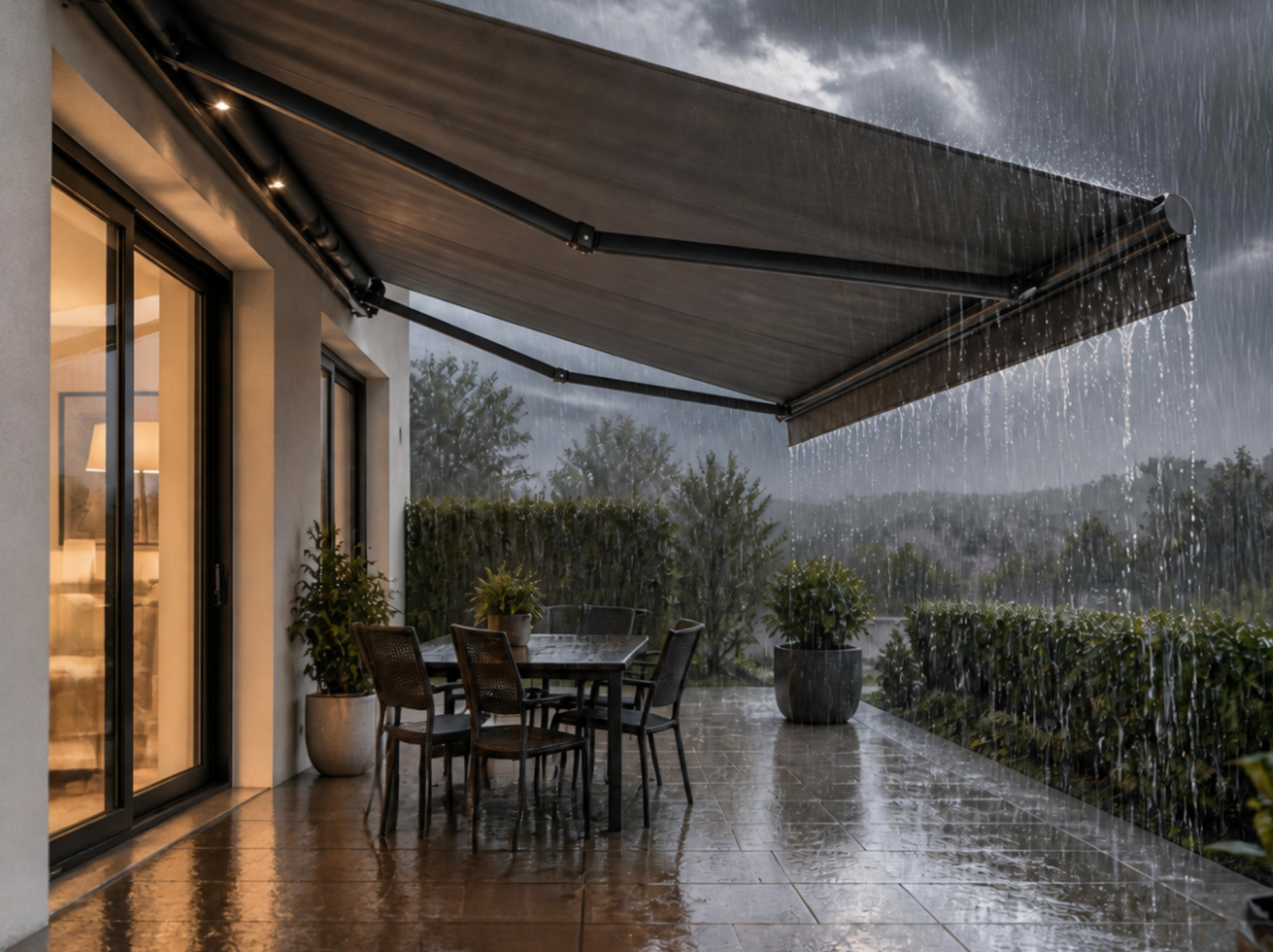
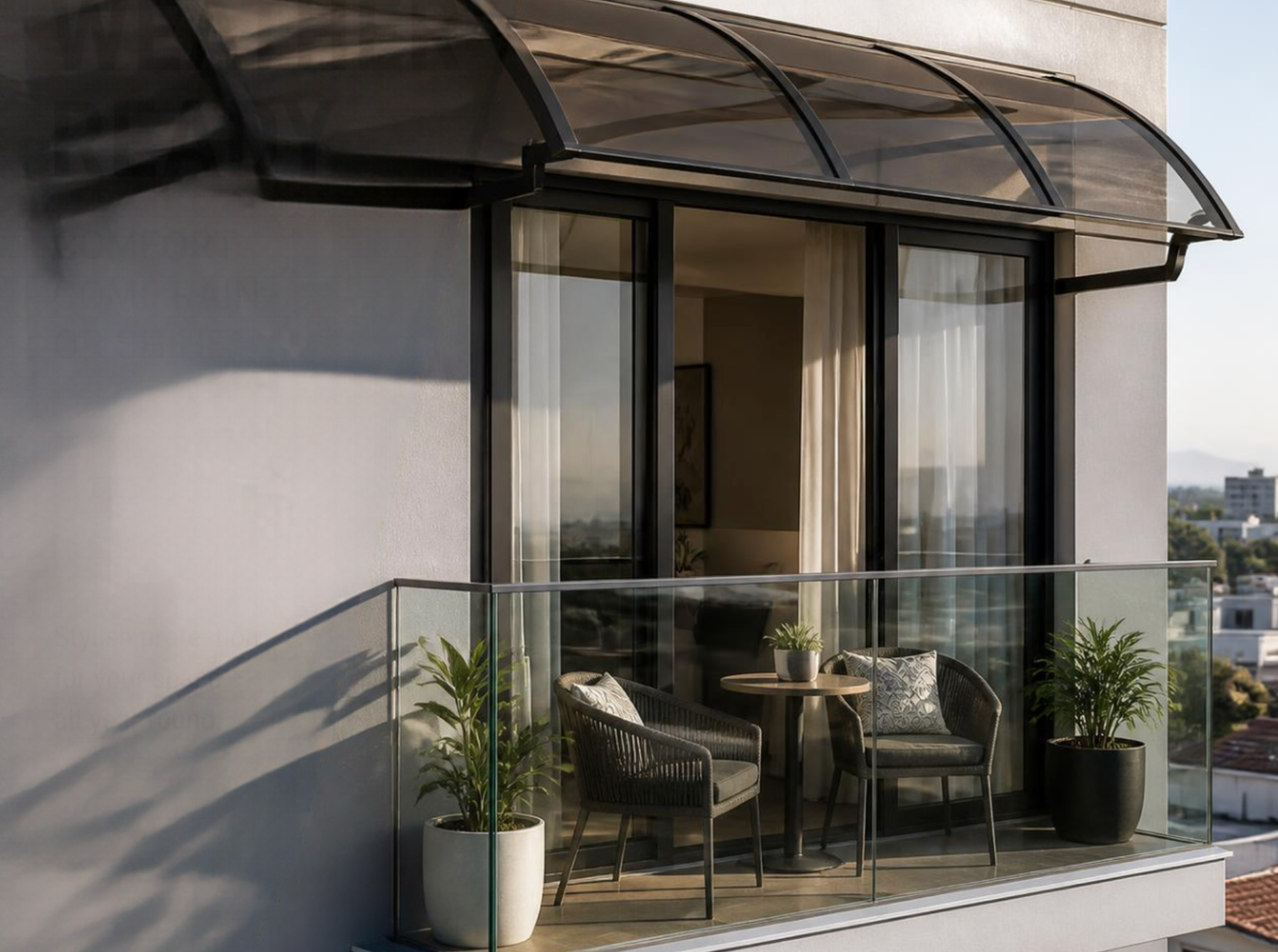
Can Polycarbonate Awnings Withstand Hail, Heavy Rain and Strong Wind in South Africa?
South African weather can be unpredictable.
One afternoon, the sun is blazing. A few hours later, dark clouds roll in, bringing heavy rain, strong winds and, in some regions, hail.
For homeowners considering an outdoor awning, this raises an important question:
Can a polycarbonate awning withstand South Africa's demanding weather conditions?
Polycarbonate is widely used in outdoor applications because of its strength, impact resistance and relatively low weight. However, the ability of an awning to withstand severe weather depends on more than the covering material alone.
The thickness and type of sheeting, support structure, mounting brackets, wall fixings and exposure of the building all play important roles.
In this guide, we explain what South African homeowners should know about polycarbonate awnings, hail, wind and heavy rain before choosing a system.
Why Weather Resistance Matters in South Africa
South Africa experiences a wide variety of weather conditions.
Inland regions, including parts of Gauteng and the Highveld, can experience powerful summer thunderstorms and hail. Coastal properties may be exposed to strong winds, driving rain and salt-laden air.
Other regions experience prolonged sunshine, intense UV exposure and seasonal temperature changes.
An awning installed outdoors must cope with these conditions over time.
That is why choosing an awning should involve more than appearance, colour or size.
The material and the complete installation must be suitable for the property's location and exposure.
What Makes Polycarbonate Suitable for Outdoor Awnings?
Polycarbonate is a thermoplastic material known for its high impact resistance.
Unlike ordinary glass, which can fracture into sharp pieces under impact, polycarbonate has a greater ability to absorb impact without breaking.
This makes it a useful material for external coverings, including window awnings, entrance canopies and patio covers.
Other advantages include:
- Relatively low weight compared with glass
- High impact resistance
- Availability in clear and tinted finishes
- Options that allow natural light through
- UV-protected grades suitable for outdoor exposure
- Suitability for curved canopy designs when correctly specified
Reboss offers polycarbonate options within its fixed awning range, allowing homeowners to combine overhead protection with a clean architectural appearance.
However, it is important to distinguish between impact-resistant and impact-proof.
No awning should be assumed to withstand every possible hailstorm or weather event.
Can Polycarbonate Awnings Withstand Hail?
This is one of the most important questions for homeowners in hail-prone areas.
Polycarbonate is generally more impact-resistant than ordinary glass, making it a practical material to consider where hail is a concern.
But hail resistance is not a single universal property.
The performance of a particular awning depends on factors such as:
- The type of polycarbonate used
- Sheet thickness and construction
- Panel span and support spacing
- The size, shape and velocity of hailstones
- The condition and age of the material
- How the sheeting is secured to the frame
A small hailstone falling during an ordinary thunderstorm creates a different impact from a large hailstone travelling at high speed during a severe storm.
For this reason, customers should ask about the specifications and any applicable impact-testing information for the actual awning system being considered.
Polycarbonate's impact resistance is an advantage, but it should not be described as an unconditional hail-proof guarantee.
Solid Acrylic vs Multiwall Polycarbonate in Hail-Prone Areas
Acrylic and polycarbonate are both popular transparent and translucent awning materials.
However, they have different characteristics.
Acrylic Awnings
Acrylic is valued for its optical clarity and premium appearance.
It can create a crisp, glass-like finish that works particularly well on modern residential and architectural installations.
Acrylic is also lighter than glass, but its impact behaviour differs from polycarbonate.
Multiwall Polycarbonate Awnings
Multiwall polycarbonate contains internal channels or chambers within the sheet.
This construction can offer a useful combination of strength, relatively low weight and thermal performance.
Polycarbonate is generally the material worth investigating first when impact resistance is a major priority.
However, a meaningful comparison should consider the exact sheet specifications rather than treating all acrylic and polycarbonate products as identical.
For a broader comparison, read our existing guide to Acrylic vs Polycarbonate Awnings: Which Material Is Right for Your South African Home?
Can Polycarbonate Awnings Handle Heavy Rain?
A correctly designed and installed fixed awning can provide useful protection against overhead rainfall.
The curved shape of many Reboss awning systems helps direct rainwater away from the canopy rather than allowing it to remain on a completely flat surface.
However, successful rain protection depends on several factors.
1. Awning Projection
Projection is the distance the awning extends outward from the wall.
A shallow window awning and a deeper entrance canopy provide different levels of coverage.
The appropriate projection depends on the opening being protected and the direction from which rain commonly arrives.
2. Installation Position
The height and location of the awning affect how well it protects the area underneath.
An awning mounted too high above an opening may allow more wind-driven rain to reach the door or window.
3. Water Runoff
Water needs to leave the awning without creating problems elsewhere.
Consider whether runoff could fall directly onto steps, walkways, balconies below or frequently used entrances.
4. Wind-Driven Rain
An open-sided awning is not a sealed enclosure.
Rain blowing horizontally can still enter beneath the canopy or from its sides.
A fixed awning therefore provides overhead weather protection, not a guarantee that the entire area underneath will remain completely dry during every storm.
What Happens When Strong Wind Hits an Awning?
Wind resistance involves more than the strength of the covering material.
When wind moves across or underneath a canopy, it creates pressure and uplift forces.
These forces are transferred through the sheeting, frame and brackets into the building.
The complete system must therefore be considered.
Important factors include:
Awning projection: A larger canopy can be exposed to greater wind forces.
Mounting height: Elevated and exposed locations may experience different wind conditions from sheltered ground-floor installations.
Building geometry: Corners, roof edges and surrounding structures can affect local wind pressure.
Bracket design: The supporting structure must be appropriate for the system.
Wall fixings: The anchors must be suitable for the actual wall material and expected loads.
A strong covering panel cannot compensate for unsuitable anchors or a weak mounting surface.
Are Fixed Awnings Better in Wind Than Retractable Awnings?
Fixed and retractable awnings operate differently.
A retractable awning may be designed to fold away when not required or when conditions become unsuitable.
A fixed awning remains permanently exposed.
This means a fixed system must be properly specified and installed for the conditions it is expected to experience.
It does not automatically follow that every fixed awning is stronger than every retractable awning.
Actual wind performance depends on the complete product design, its tested or engineered limits and the quality of installation.
For a Reboss fixed awning, it is especially important to choose the appropriate system and mounting arrangement for the location.
Why Brackets and Wall Fixings Are So Important
Homeowners naturally pay attention to the canopy material because it is the most visible part of the installation.
But the brackets and anchors are just as important.
Reboss offers different bracket systems across its H-, D-, M-, P- and R-Series products.
The correct system should be selected according to the required projection, installation details and intended application.
The wall itself also matters.
A fixing suitable for sound structural concrete may not be suitable for lightweight blockwork, deteriorated masonry or a hollow substrate without an appropriate engineered solution.
Before installation, establish:
- What material the wall is made from
- Whether the mounting surface is sound
- Which anchors are specified
- Whether the required fixing positions are available
- Whether the location is unusually exposed to wind
- Whether professional structural assessment is necessary
This becomes especially important for elevated installations and awnings above areas used by people.
Which Reboss Awning Should You Choose for an Exposed Area?
Reboss offers several fixed awning systems with different projections.
The range includes compact options for windows and doors, as well as larger systems intended for applications requiring more coverage.
However, selecting a larger series does not automatically mean the installation will be suitable for a more severe wind environment.
A greater projection can also change the forces acting on the structure.
The correct approach is to choose the awning based on the opening, exposure, mounting conditions and relevant product specifications.
Our H-Series vs D-Series vs M-Series vs P-Series vs R-Series guide explains the different systems and projections.
Can UV Exposure Damage an Awning Over Time?
South Africa's strong sunlight is another important consideration.
Outdoor materials are exposed to ultraviolet radiation, heat and repeated temperature changes.
Polycarbonate intended for exterior applications typically incorporates UV protection to help resist weathering.
However, not all polycarbonate sheets are manufactured to the same specification.
The protective treatment, installation orientation and manufacturer's care requirements should be checked for the product being used.
Regular cleaning and inspection can also help identify surface deterioration or damage before it becomes more serious.
What Should You Check After a Hailstorm?
Even if an awning appears to have survived a storm, it is sensible to inspect it from a safe location.
Look for:
- Cracks or punctures in the covering
- Unusual dents or impact marks
- Loose or displaced panels
- Changes in bracket alignment
- Movement around wall fixings
- Debris trapped against the wall
- Signs of unexpected water ingress
Do not climb onto the awning or place weight on the canopy.
If the installation is high above ground or there is visible structural damage, arrange a professional inspection.
A damaged panel or loose fixing should be assessed before the awning is relied upon again.
How to Prepare Your Awning for Summer Storms
Preventative maintenance can make it easier to identify problems before severe weather arrives.
A practical checklist includes:
- Remove leaves and loose debris.
- Clean the covering using suitable methods.
- Check for visible damage to the sheeting.
- Look for movement around brackets and anchors.
- Check that water can run off normally.
- Inspect the wall around mounting points.
- Arrange professional assistance where structural concerns are visible.
Avoid abrasive cleaners or aggressive cleaning methods that could damage acrylic or polycarbonate surfaces.
For a more detailed maintenance guide, see our article Awning Maintenance South Africa: How to Prepare Your Awnings for Summer Rain, Heat & Storms.
Choosing an Awning for South African Weather
When comparing awnings, ask more than whether the covering is made from acrylic or polycarbonate.
Consider the complete installation.
The most useful questions are:
- Is the covering material appropriate for the environment?
- What are the exact panel specifications?
- Are impact-testing details available?
- Is the complete awning suitable for the expected wind exposure?
- What wall fixings are required?
- How will rainwater be managed?
- What maintenance is recommended?
- What do the product warranty and any exclusions cover?
These questions help establish realistic expectations about durability and performance.
Reboss Polycarbonate Awnings for South African Homes
A well-chosen awning can provide valuable protection from direct sunlight and overhead rain while complementing the appearance of your property.
Polycarbonate is particularly worth considering where impact resistance, natural light and outdoor durability are important.
However, the best result comes from matching the complete awning system to the building and its environment.
Reboss offers fixed modular awnings in different sizes, projections and covering options for residential applications.
Explore the Reboss range and request advice on the right awning for your installation.
Frequently Asked Questions
Are polycarbonate awnings hail-proof?
Polycarbonate is highly impact-resistant compared with ordinary glass, but no awning should be assumed to withstand every hailstorm. Performance depends on the actual material, panel design, support structure and severity of the impact.
Can a fixed awning withstand strong wind?
A properly specified and installed fixed awning can be suitable for outdoor exposure, but its wind resistance depends on the complete system, location, wall construction and fixings. Ask for the relevant product specifications rather than assuming a universal wind rating.
Do curved awnings prevent rainwater from collecting?
A curved canopy helps encourage water runoff, but effective drainage also depends on installation, panel geometry and surrounding conditions.
Is polycarbonate better than acrylic for hail-prone areas?
Polycarbonate generally offers greater impact resistance than acrylic, making it worth considering in hail-prone locations. The exact products and their specifications should still be compared.
Should I replace my awning after a hailstorm?
Not necessarily. First assess whether there is visible damage. Cracked panels, displaced components or movement around fixings should be professionally evaluated before continued use.
Can I install a polycarbonate awning myself?
Some installations may be suitable for competent DIY work, but elevated, exposed or structurally complex installations should be professionally assessed. Correct anchors and a sound mounting surface are essential.
Contact us -
https://www.reboss.co.za/contact
RELATED POSTS