Balcony Awnings South Africa: How to Create a Shaded, Weather-Protected Balcony
A balcony should be one of the most enjoyable spaces in a home.
It's somewhere to enjoy your morning coffee, grow a few plants, relax after work or simply open the doors and bring more fresh air into your living space.
But South African weather can make an uncovered balcony surprisingly difficult to use.
Strong sunshine can make the area uncomfortable during the hottest part of the day. Sudden rain can send you rushing to bring cushions and furniture inside. And balconies exposed to afternoon sun can also allow significant sunlight to reach the windows or doors behind them.
Installing a balcony awning can provide a practical solution without completely enclosing the space.
The key is choosing the right type, size, projection and covering material for your particular balcony.
Here's what to consider.
Why Install an Awning Over a Balcony?
Unlike an enclosed room, a balcony is deliberately exposed to the outdoors.
That's part of its appeal.
The objective of an awning therefore isn't necessarily to turn your balcony into another indoor room. Instead, it creates overhead protection while allowing the area to remain open.
A well-positioned awning can help provide:
- Shade from direct sunlight
- Protection from overhead rain
- Greater comfort during hot weather
- Protection for outdoor furniture
- Reduced direct sunlight around balcony doors and windows
- A more usable outdoor living area
- An attractive architectural feature
Reboss specifically lists balconies among the applications for its modular awning systems.
Balcony Shade Is About More Than Comfort
Most people initially consider an awning because they want somewhere shaded to sit.
But the position of a balcony often means the benefits extend beyond the outdoor space itself.
Many balconies sit directly outside large sliding doors.
When direct sunlight reaches that glazing, solar energy can contribute to heat build-up inside the adjoining room.
External shading can help because it intercepts some direct sunlight before it reaches the glass .
This can be particularly useful for balconies exposed to strong afternoon sunshine.
Reboss discusses this principle in its existing guide to how external awnings can help reduce heat entering South African homes.
So when choosing a balcony awning, think about two spaces:
the balcony itself and the room immediately behind it.
Consider Which Direction Your Balcony Faces
Orientation is one of the most important—and frequently overlooked—factors when selecting balcony shade.
A balcony that receives morning sun behaves very differently from one exposed to intense late-afternoon sunlight.
In South Africa, the sun's position also changes throughout the year.
Before deciding on the size of your awning, observe your balcony at different times of day.
Ask:
When does direct sunlight reach the balcony?
How far into the balcony does it penetrate?
Does sunlight reach the doors or windows behind it?
Is your biggest problem midday sun or lower afternoon sun?
An awning provides overhead protection, but low-angle sunlight can still enter underneath the front of a canopy.
That means the largest awning isn't automatically the perfect solution.
The orientation and geometry of the space matter too.
How Much Projection Does a Balcony Awning Need?
Projection refers to how far the awning extends outward from the wall.
This is particularly important on a balcony because space is usually limited.
Too little projection may provide insufficient coverage.
Too much projection may be inappropriate for the dimensions or structure of the balcony.
The current Reboss range provides several projection options. Its P-Series, for example, has a 1200 mm projection and is specifically positioned for applications including patios and balconies .
The larger R-Series extends farther, while smaller systems are available where less projection is required.
Rather than starting with a particular product, start with the balcony.
Measure the space first, establish how much coverage you need and then identify the system that suits those dimensions.
Our H-Series vs D-Series vs M-Series vs P-Series vs R-Series guide explains the different Reboss projections in more detail.
Width Matters Too
Projection determines how far the awning extends outward.
Width determines how much of the balcony it covers from side to side.
If your balcony has a wide sliding door, an awning that only covers the exact width of the opening may leave areas alongside it exposed.
Think about what you're actually trying to protect.
If the objective is mainly to protect a doorway, the required width may be relatively modest.
If you want to create a shaded seating area, you'll need to consider where the table, chairs or other furniture will sit.
For wider balconies, the solution may involve more than one awning unit depending on the layout and installation.
Clear or Tinted Balcony Awning?
This is where balcony installations become particularly interesting.
You want protection—but you probably don't want to make the adjoining room unnecessarily dark.
Clear Covering
A clear acrylic or polycarbonate covering allows substantial natural light through the canopy.
This can be particularly useful on balconies outside living rooms, bedrooms or kitchens where maintaining daylight indoors is important.
It also helps the balcony retain an open feeling.
Bronze or Tinted Covering
If excessive sunlight and glare are the main problems, a bronze or tinted covering may be more appropriate.
Tinting can reduce the intensity of light beneath the awning while still allowing daylight through.
Reboss currently offers different clear, bronze and tinted covering options across its acrylic and polycarbonate ranges.
The best option depends on the balcony's orientation and how much natural light you want in the room behind it.
Acrylic or Polycarbonate?
Once you've considered transparency, you'll also need to choose the material itself.
Acrylic
Acrylic is particularly attractive where visual clarity and architectural appearance are priorities.
A clear acrylic canopy can have a crisp, almost glass-like appearance while providing a lightweight alternative to glass.
This can work particularly well on modern balconies where you don't want the canopy to dominate the architecture.
Polycarbonate
Polycarbonate provides another durable option for exterior awnings and is available in different configurations and tints.
Multiwall polycarbonate can be especially useful where durability and a balance between natural light and shade are priorities.
Will an Awning Keep All Rain Off a Balcony?
If you're deciding between the two, Reboss already has a dedicated guide covering acrylic vs polycarbonate awnings , including the advantages and applications of each material.
This is an important expectation to manage.
An awning provides overhead weather protection , but a balcony remains an open-sided outdoor space.
Wind-driven rain can still enter from the front or sides.
How much protection you receive will depend on factors including:
- Awning projection
- Balcony depth
- Wind direction
- Installation height
- Building orientation
- Surrounding architecture
So it is better to think of an awning as creating a more weather-protected balcony , rather than turning an open balcony into a waterproof room.
That distinction is particularly important if you're choosing furniture or storing items outside.
Think About Water Run-Off
Rain landing on the awning needs somewhere to go.
The curved profile used by Reboss systems is designed to allow water to run away rather than remaining on a flat horizontal surface.
However, the surrounding balcony still needs to manage that water appropriately.
Consider where water will discharge and whether it could create problems for balconies or pedestrian areas below.
This is especially important in apartment buildings.
What About Wind?
Balconies can sometimes experience stronger or more turbulent wind than ground-level patios, particularly on taller buildings or exposed façades.
That makes the installation itself extremely important.
The wall construction, bracket selection, fixings and installation position all need to be appropriate for the building and application.
A balcony installation several floors above ground should not automatically be treated like a simple ground-floor DIY project.
Where access, structural requirements or exposure make the installation more complex, professional assessment and installation may be the appropriate route.
Apartment Balconies: Check Before You Install
If you own an apartment or sectional-title property, there's another step before choosing your awning:
check what alterations you're permitted to make to the exterior of the building.
A balcony may form part of your unit, but an awning can alter the external appearance of the building and requires fixing to the structure.
Body corporate rules, building management requirements or other approvals may therefore apply.
Requirements differ between properties, so don't assume that because another balcony has an awning, you can automatically install the same thing.
Before ordering, establish whether approval is required and whether there are rules regarding:
- Awning colour
- Size
- Mounting position
- Exterior appearance
- Approved contractors
- Structural fixings
Getting approval first can prevent unnecessary problems later.
Balcony Awnings for Houses
Of course, balcony awnings aren't limited to apartments.
Many South African homes have upper-level balconies outside bedrooms, lounges or entertainment spaces.
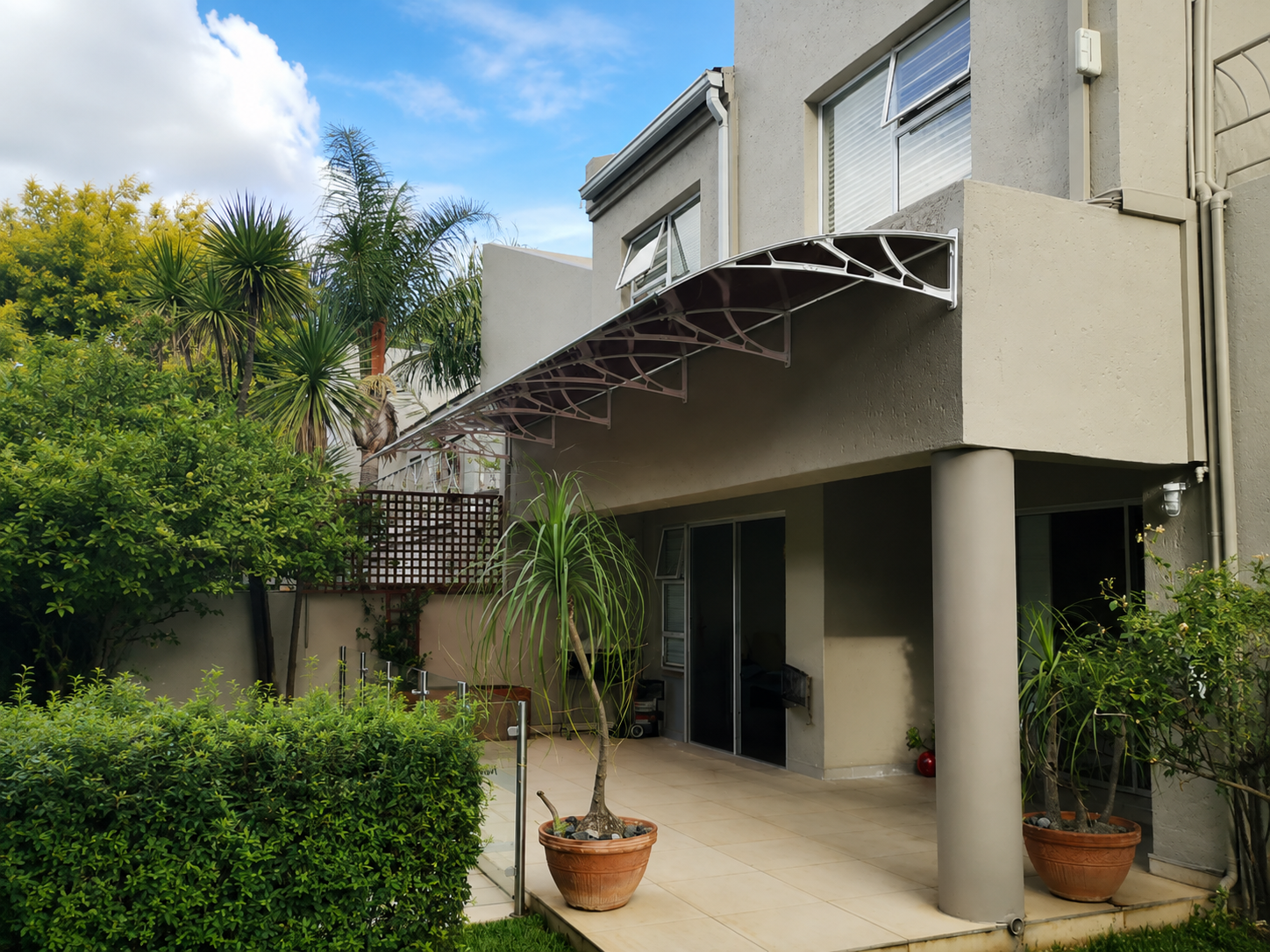
Here, an awning can create a particularly attractive architectural feature.
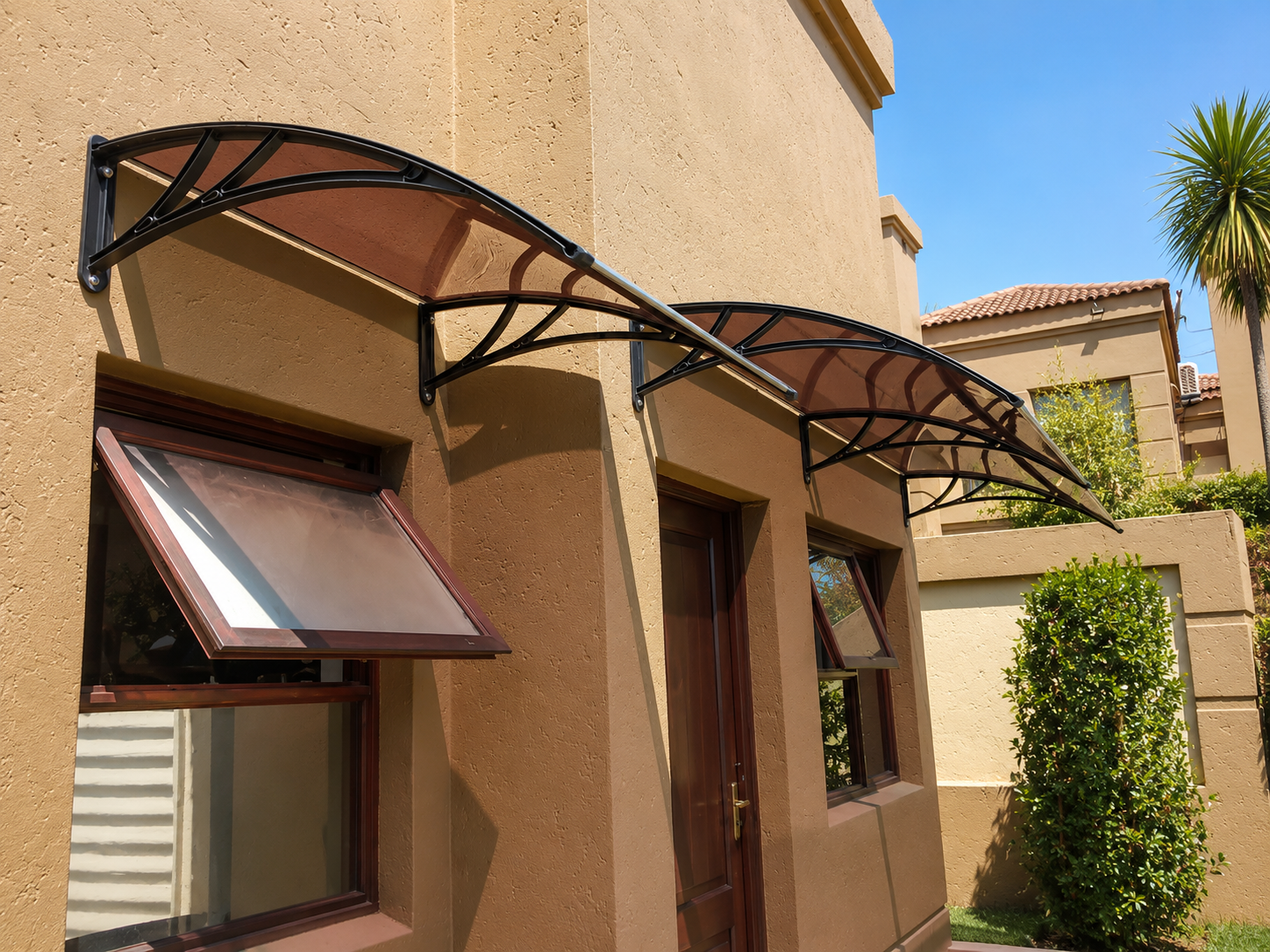
A clear or lightly tinted curved canopy can provide weather protection while retaining views from the balcony.
It can also protect doors and windows positioned beneath the canopy.
For upper-floor installations, however, safe access becomes an important consideration.
Professional installation may be preferable where ladders, scaffolding or specialist access equipment would otherwise be required.
Protecting Balcony Furniture
Outdoor furniture is designed to live outside, but constant exposure still takes its toll.
Sunlight can contribute to fading and deterioration of fabrics and finishes, while regular rain means cushions and other items may constantly need to be moved indoors.
An overhead awning reduces direct exposure.
It won't completely protect furniture from sideways rain or all UV exposure, but it can make the balcony easier to manage and more convenient to use.
That can make the difference between a balcony that's used regularly and one that gradually becomes an outdoor storage area.
What About Plants?
Balcony plants can also benefit from partial overhead protection—but choose carefully.
Some plants thrive in full sun while others prefer filtered light.
A clear canopy creates a different growing environment from a bronze or tinted covering.
If plants are an important part of your balcony, consider their light requirements when selecting the canopy material.
Remember that an awning also changes how much natural rainfall reaches pots underneath it, so plants may require more deliberate watering.
Measuring for a Balcony Awning
Before choosing a product, take several measurements.
1. Measure the Width
Measure the total area you want protected, not only the door or window.
2. Measure the Balcony Depth
How far does the balcony extend outward from the wall?
This gives you an indication of how much projection may be useful.
3. Check the Mounting Area
Look at the wall above the opening.
Is there sufficient space to mount the awning at the required height and angle?
4. Identify Obstructions
Look for:
- Exterior lights
- Gutters
- Downpipes
- Security equipment
- Air-conditioning equipment
- Balustrades
- Architectural features
5. Consider What's Below
This is particularly important for elevated balconies.
Think about where rainwater will go and whether installation or future maintenance can be performed safely.
Which Reboss Awning Is Suitable for a Balcony?
There isn't a universal answer because balcony sizes and buildings vary considerably.
However, the P-Series is particularly relevant because Reboss specifically positions its 1200 mm projection for applications including balconies and patios .
Other systems may be appropriate where different projections are required.
The decision should therefore be based on:
Width + projection + material + orientation + mounting conditions.
Choosing all four together produces a much better result than selecting an awning purely by appearance.
Maintaining a Balcony Awning
Once installed, basic maintenance helps keep an awning looking good and gives you an opportunity to spot problems early.
Remove leaves and loose debris periodically and clean acrylic or polycarbonate surfaces gently using appropriate methods.
Fixings and brackets should also be inspected periodically, particularly after unusually severe weather.
This connects directly with our second October article, Awning Maintenance South Africa: How to Prepare Your Awnings for Summer Rain, Heat & Storms , which provides a complete maintenance checklist.
Creating a Balcony You'll Actually Use
The real value of a balcony isn't measured in square metres.
It's measured by how often you use it.
A beautiful balcony that becomes unbearably hot at midday or unusable whenever it rains isn't delivering its full potential.
The right awning can make that space more comfortable and practical without taking away the outdoor feeling that makes a balcony appealing in the first place.
Start by understanding the sun, weather and dimensions of your balcony.
Then choose the projection, material and level of transparency that complement both the outdoor area and the room behind it .
The result can be a balcony that becomes a genuine extension of your living space.
Find the Right Reboss Awning for Your Balcony
Reboss offers modular awning systems in different projections and covering options for residential applications including balconies, patios, windows and doors.
Whether you're shading an apartment balcony or protecting an upstairs entertainment area, choosing the right solution begins with accurate measurements and an understanding of how the space is exposed to the weather.
Frequently Asked Questions
What is the best awning for a balcony?
The best option depends on the balcony's width, depth, orientation and mounting conditions. Reboss's P-Series is specifically positioned for balcony and patio applications and provides approximately 1200 mm projection. Other systems may be suitable where a different projection is required.
Will a balcony awning stop rain?
It can provide protection from overhead rain, but an open balcony isn't completely weatherproof. Wind-driven rain can still enter from the front and sides.
Should I choose a clear or tinted balcony awning?
Clear coverings are useful when maintaining natural light is important. Bronze or tinted coverings can be considered where stronger sunlight and glare are concerns. The balcony's orientation and the room behind it should both influence the decision.
Can I install an awning on an apartment balcony?
Potentially, but check your building or body corporate requirements before ordering or drilling into the exterior structure. Approval requirements vary between properties.
Can balcony awnings help shade sliding doors?
Yes. Where an awning projects above balcony doors, it can intercept some direct sunlight before it reaches the glazing. The effectiveness depends on the orientation, sun angle and awning dimensions.
Can I install a balcony awning myself?
That depends heavily on the installation. Ground-level work is very different from mounting an awning several floors above ground. Difficult access, uncertain wall construction or exposed elevated locations are good reasons to consider professional installation.
RELATED POSTS